
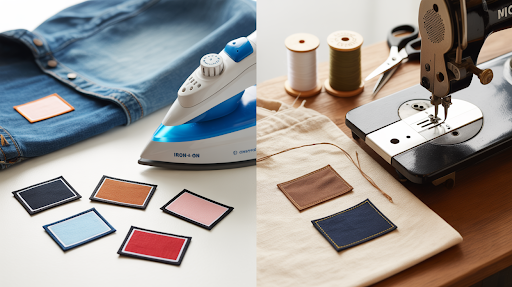
There’s a moment every brand manager, merch designer, or small business owner in Canada hits, the crossroads of all crossroads: “Should I go with iron-on patches or sew-on patches?”
It starts off innocent. You’re browsing custom patch options, thinking, “This will be easy.” But then boom, suddenly you’re comparing glue strength, fabric types, washing cycles, temperature resistance, and wondering if sewing is still a survival skill your grandma tried to teach you.
And since custom patches have become the unofficial uniform for Canadian businesses, sports teams, creators, breweries, cafés, construction companies, and everyone in between, the debate matters. Both options slap… but in very different ways.
Today, we’re breaking it all down, Canadian-style. Meaning: clear, practical, witty, no-fluff, and sprinkled with just enough charm that you don’t feel like you’re reading a hardware instruction manual. Let’s settle the ultimate showdown: Iron-on vs Sew-on Patches.
What Makes This Comparison Worth Your Time?
Because choosing the wrong type of patch is basically like wearing Crocs to a formal wedding, technically doable, but deeply questionable. Here’s what’s at stake:
- Durability
- Washability
- Brand consistency
- Long-term usage
- Placement flexibility
- Effort required
- The final look and feel
And of course… your patch budget.
Whether you’re customizing uniforms with patches for your team, creating merch for your brand, or just trying to look cool without trying too hard, this breakdown is your shortcut to making a smart choice.
Let’s Start With Iron-On Patches (AKA: The “Hot and Handy” Option)
Iron-on patches are Canada’s not-so-secret cheat code for quick branding and instant style. They come with a heat-activated adhesive backing, warm them up, press them down, and boom: patch secured. These are perfect when you want:
- Fast application
- A clean, finished look
- Strong bonding without stitching
- Non-stretch fabrics
- Event merch or uniforms with tight deadlines
Why Canadians Love Iron-On Patches
Let’s be honest, we’re busy. Between snow, work, hockey, and randomly long Tim Hortons lines, nobody’s got time for complicated branding processes. Iron-on patches save the day with:
- Quick installation (5–10 minutes)
- Consistent results
- Smooth finish
- No sewing machine or hand-stitch skills required
This is why businesses that need last-minute promo merch or urgent uniform branding lean heavily towards iron-ons.
But… they’re not perfect.
The heat adhesive is tough, but it has one enemy: stretchy fabrics. If you try ironing a patch onto leggings or athletic wear, it’s not going to end well. The fabric moves, your custom patch… doesn’t.
So iron-ons shine brightest on:
- Denim
- Canvas
- Non-stretch jackets
- Caps
- Cotton
- Uniform shirts
- Workwear
If the fabric has structure, iron-ons are your hero.
Now, Let’s Talk Sew-On Patches (AKA: The “Forever Loyal” Option)
If iron-ons are about convenience, sew-ons are about commitment. They’re the reliable cousin who shows up early, helps set up, and stays to clean afterward. Sew-on patches don’t rely on glue, they rely on stitching. And stitching = strength.
Why Sew-On Patches Are a Big Deal in Canada
Sew-on patches are the MVP when you want:
- Maximum durability
- Heavy-duty usage
- Patches that survive the wild Canadian laundry cycle
- Compatibility with stretchy fabrics
- Long-term uniforms and workwear
Canadian businesses who want their branding to last through:
- Construction sites
- Manufacturing floors
- Long winters
- Frequent washes
- Outdoor environments
…usually go sew-on. If your brand values long-term durability over convenience, sew-on patches are the more dependable option, no contest.
Downside? Effort.
Sewing takes:
- Time
- A needle
- Thread
- (And ideally) Basic hand-stitch skills
It’s not complicated, just slightly manual. But the trade-off is worth it for the lifespan you get. If you want a deeper dive specifically about sew-on patches, this guide lays it out perfectly: All You Need to Know About Sew-on Patches in Canada.

Iron-On vs Sew-On: The Quick-Compare Breakdown
Here’s your Canadian cheat sheet:
| Feature | Iron-On Patches | Sew-On Patches |
| Application | Heat + Pressure | Needle + Thread |
| Durability | High | Extremely High |
| Wash Resistance | Good | Excellent |
| Skill Level | Very Easy | Moderate |
| Best For | Fast branding, structured fabrics | Stretch fabrics, uniforms, heavy use |
| Look & Finish | Clean & flat | Slightly raised & rugged |
| Lifespan | Great | Next-level |
This is where most brands go: Iron-on for quick impact. Sew-on for long-term commitment.
How Businesses Across Canada Actually Use Them
Canadian brands rarely choose patches based on vibe alone, they choose based on use-case.
Iron-on patches dominate:
- Corporate events
- Pop-up merch
- Apparel drops
- Team jerseys
- Limited-run uniforms
- Nonprofit campaigns
Sew-on patches dominate:
- Workwear branding
- Outdoor gear
- Reusable uniforms
- Hospitality uniforms
- Tactical or professional gear
Let’s Talk Money: Which Costs More?
Here comes the fun part, how much are you paying for each?
Iron-On Pricing
The addition of adhesive backing costs slightly more per patch. But the application time? Faster. Much faster. If you’re DIY-ing or branding multiple items yourself, iron-ons save both labor and time.
To dive deeper into iron-on patches specifically, here’s a resource that pairs perfectly with this comparison: Complete Guide to Iron-On Custom Patches in Canada.
Sew-On Pricing
The patch itself is usually the same price as an iron-on version but the sewing labor will cost more if outsourced. If you sew at home? Free. If you take it to a tailor? Expect minor additional costs.
TL;DR:
- Iron-on: Slightly higher patch cost, zero application labor.
- Sew-on: Same patch cost, but sewing labor adds up.
Your budget will tell you which lane to pick.
A Quick Fabric Compatibility Chart
| Fabric Type | Iron-On | Sew-On |
| Denim | Excellent | Excellent |
| Canvas | Excellent | Excellent |
| Cotton | Great | Great |
| Polyester | Good | Excellent |
| Stretch fabrics | Weak | Perfect |
| Nylon | Weak | Strong |
| Thick uniforms | Good with heat press | Excellent |
| Leather | Not recommended | Possible (with pro stitching) |
If your fabric doesn’t like heat or is stretchy – Sew-on. If your fabric is structured and heat-friendly – Iron-on.
FAQs
Which lasts longer: iron-on or sew-on patches?
Sew-on patches last longer, especially on stretchy or heavily washed fabrics.
Are iron-on patches strong enough for uniforms?
Yes, on structured fabrics. But for heavy-duty uniforms, sew-ons are more reliable.
Can I iron-on a patch and sew it as well?
Absolutely. Many Canadian brands go hybrid for best results.
Do iron-on patches fall off over time?
Not if applied correctly and used on compatible fabrics. But stretch fabrics weaken the bond.
Are sew-on patches harder to apply?
They take more time, but the result is extremely durable.
Now What to Do Next…
At the end of the day, you don’t just want patches that look good, you want patches that perform, stand out, and elevate your branding across Canada. Whether you choose iron-on or sew-on, you deserve patches that don’t peel, don’t fade, don’t fall off, and don’t embarrass your brand
And that’s exactly what we create at Eagle Patches Canada, premium custom patches made for real Canadian weather, real Canadian workplaces, and real Canadian apparel. Ready to get your custom patches made? Iron-on or sew-on, Eagle Patches Canada will craft them exactly the way your brand needs.