
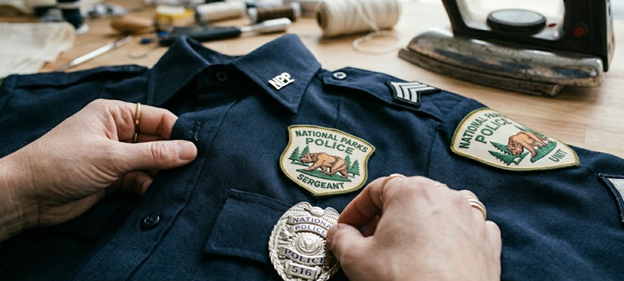
A police uniform communicates authority before a single word gets spoken. Every element of that uniform carries meaning, and police patches sit at the centre of that visual language. They identify the officer, the department, the rank, and the unit at a glance.
Police uniform patches also follow institutional standards that govern placement, design, colour, and material. Getting any of those wrong creates compliance problems and inconsistency across a department.
This guide covers everything a department, procurement officer, or uniform supplier needs to know about custom police patches. It includes materials and backing options, design standards, placement rules, and maintenance.
What Are Custom Police Patches for Uniforms?
Custom police patches are fabric or moulded insignia attached to law enforcement uniforms to identify officers by department, rank, unit, and jurisdiction. They serve as the primary visual identification system on a uniform, communicating institutional affiliation and authority.
Unlike generic patches, custom police patches get designed to meet the specific branding, colour, and insignia standards of the individual department ordering them. Every element, from the shield shape and typography to the colour palette and border style, reflects the specific identity of that law enforcement agency.
Why Use Custom Police Patches for Uniforms?
Police patches do far more than mark ownership of a uniform. They carry institutional authority, build public trust, and serve operational functions that generic insignia cannot replicate. Understanding the full range of benefits explains why departments treat patch quality and consistency as non-negotiable.
Benefits of Custom Police Patches
- Identification clarity allows members of the public, fellow officers, and other agencies to identify an officer’s department and rank instantly.
- Authority representation gives the uniform its visual weight. A sharp, well-produced patch on a clean uniform projects the professionalism and institutional credibility.
- Durability under operational conditions separates professionally produced police patches from consumer alternatives.
- Professionalism and standardisation across an entire department requires consistent patch quality.
- Compliance with institutional standards drives patch specification in larger agencies. Federal, state, and municipal law enforcement bodies often publish detailed requirements for patch design, placement, and material.
History of Police Patches
Police patches trace their origins to military insignia traditions where units used distinctive symbols to identify themselves on the battlefield. Through the late nineteenth and early twentieth centuries, police departments formalised their insignia systems as forces grew and public-facing identity became institutionally important.
The mid-twentieth century introduced machine embroidery, allowing consistent reproduction across large uniform orders. It also transformed department patches into standardized production items rather than hand-crafted pieces. As equipment improved, design complexity increased.
Modern police patches now use embroidered, woven, PVC, and rubber construction depending on the application. Tactical units moved toward subdued low-visibility designs on darker base fabrics. The evolution reflects both technology and the changing operational demands placed on law enforcement across different environments and roles.
Types of Materials Used for Custom Police Patches
Material selection for custom police patches determines durability, visual impact, tactile quality, and performance under the specific conditions the uniform faces. Each material serves different operational and aesthetic requirements.
| Material Type | Best Use Case | Durability | Visual Appearance | Key Advantage | Limitations |
| Embroidered Patches | Standard police uniforms, formal wear | High | Textured, raised stitching | Classic look, strong thread durability | Limited fine detail for small text |
| PVC (Rubber) Patches | Tactical units, outdoor operations | Very High | 3D raised, bold design | Waterproof, weather-resistant, long-lasting | Less traditional appearance |
| Woven Patches | Detailed logos, small text-heavy designs | Medium–High | Flat, smooth finish | High detail precision, clean lines | Less texture compared to embroidery |
| Printed Patches | Complex designs, gradients, photo-like images | Medium | Smooth, ink-based surface | Unlimited color and detail options | Less durable over time |
| Leather Patches | Premium uniforms, ceremonial use | High | Natural, rugged finish | Unique aesthetic, premium feel | Limited color options, higher cost |
| Chenille Patches | Decorative or honorary patches | Medium | Fuzzy, raised texture | Bold and highly visible | Not suitable for tactical or heavy-duty use |
Backing Options for Police Uniform Patches
Backing selection determines how securely the patch attaches to the uniform and how well that attachment holds through the demands of operational use and repeated laundering.
- Sew-on backing is the professional standard for police uniform patches across most departments and jurisdictions.
- Velcro hook-and-loop backing suits tactical applications where officers need to transfer patches between different uniform configurations or where patch sets change depending on the operational role.
- Iron-on backing sees limited use in law enforcement uniform applications because the adhesive bond degrades faster than sew-on under the high-frequency washing that police uniforms require.
- Adhesive backing suits temporary or event-specific identification rather than permanent uniform patches.
Where to Place Police Patches on Uniforms
Patch placement on police uniforms follows departmental standards that vary by jurisdiction but share consistent underlying principles across most law enforcement organisations.
Chest placement carries the primary department identification badge or shield patch, positioned above the breast pocket on the left chest in most jurisdictions. This placement positions the primary identification at eye level during face-to-face interaction.
Shoulder placement accommodates department or jurisdiction patches on one or both sleeves, typically positioned at the top of the sleeve below the shoulder seam. Shoulder patches identify the department or agency and often carry the most visually complex design of the patch set.
Sleeve positioning for additional unit or division patches follows the shoulder patch, placed sequentially below it with consistent spacing. The order typically moves from highest institutional authority at the top to most specific unit identification below.
FAQs
What are police patches used for?
Police patches identify officers by department, rank, jurisdiction, and unit. They serve as the primary visual identification system on a law enforcement uniform.
Are custom police patches mandatory?
Requirements vary by jurisdiction and department. Most law enforcement agencies specify mandatory patch placement and design standards as part of their uniform regulations.
Which material is best for police uniform patches?
Embroidered patches on twill base fabric remain the institutional standard for traditional police uniform applications. PVC or rubber construction suits tactical and specialised unit applications where weather resistance and operational durability take priority over traditional aesthetics.
Can police patches be washed frequently?
Yes, when produced and attached correctly. Sew-on patches on quality base fabric survive hundreds of wash cycles when laundered in cold water on gentle cycles with mild detergent.
What is the most durable backing option?
Sew-on backing provides the most durable attachment for police uniform patches across all fabric types and washing frequencies.
Conclusion
A police patch does not simply decorate a uniform. It identifies an institution, projects authority, and communicates the professionalism that public trust in law enforcement is built on. Departments and procurement officers who understand these standards produce uniforms that withstand the full demands of operational service.
Eagle Patches Canada produces custom police patches to the institutional standards that law enforcement uniforms demand. From design consultation and material selection to production, quality inspection, and delivery, we handle every stage of the process with the precision and professionalism the application requires.