Compared to a promotional or team patch, custom patches designed for Canadian military and law enforcement clothing have greater obligation. They can quickly identify rank, unit, and jurisdiction, maintain their color and form after years of use, washing, and exposure to the elements, and frequently require a backing designed for tactical equipment rather than a jacket.
Construction, color accuracy, and backing selection are just as important as the artwork itself, whether you are purchasing custom police patches Canada for a full department or sourcing custom military patches Canada for a unit rollout.
The difference between military and law enforcement patches, materials and backings that withstand active duty, and the design and ordering procedures that ensure a bulk order is accurate the first time are all covered in this guide.
Why Uniform Patches Matter for Military and Law Enforcement
On a uniform, a patch is not decoration, it is identification. A shoulder flash tells a bystander which police service they are looking at. A formation patch tells another service member what unit someone belongs to before either speaks. For departments, units and organizations that need custom patches for uniforms, choosing the right material, backing and size is just as important as the artwork itself.
Because of that, military uniform patches and police uniform patches Canada wide are held to tighter standards than a hobby or team order: exact colour matching against a regulation reference, consistent sizing across every piece, and a backing chosen for how the patch is actually worn, whether that is a permanently sewn dress uniform or a plate carrier where patches are swapped between assignments.
In a small order, making a mistake in a detail is a minor problem. The specification step is more important in bulk order than in most custom patch projects since making a mistake on a departmental or unit order would require reissuing hundreds of fixes.
Military Patches vs Law Enforcement Patches: Key Differences
Military uniform patches and law enforcement patches share a manufacturing process but serve different chains of approval and different visual rules. The table below summarises the main distinctions.
| Feature | Military Patches | Police & Law Enforcement Patches |
|---|---|---|
| Typical purpose | Unit, formation, rank, and name identification | Department, rank, and jurisdiction identification |
| Common styles | Formation patches, rank patches, name tapes, morale patches | Shoulder flash, crest patches, badge patches, ID panels |
| Colour approach | Often low-visibility or subdued tones for field uniforms | Typically full colour to match department branding |
| Common backing | Velcro for tactical gear, sew-on for dress uniforms | Sew-on for standard uniforms, Velcro for tactical or vest use |
| Approval path | Unit or branch authorisation required | Department or municipal authorisation required |
Types of Custom Military Uniform Patches
Canadian Armed Forces patches cover a wide range of identification needs, and most units order more than one style at once so name tapes, rank, and formation patches match in colour and thread weight. Common categories include:
- Custom army unit patches and military branch patches identifying a specific regiment, squadron, or division
- Military rank patches and military name tape patches for individual uniform identification
- Military formation patches and military identification patches worn at the shoulder or chest
- Canadian flag uniform patches, often paired with a unit patch on the opposite shoulder
- Military morale patches Canada units use for esprit de corps on Velcro-backed gear rather than the dress uniform
- Military commemorative patches made for remembrance occasions, deployments, or anniversaries
- Tactical military patches made for low-visibility uniforms and plate carriers fall into a similar category as Multi-Terrain (MT) modernized combat uniform patches, where a sturdy Velcro backing and color matching against the CADPAT pattern are more important than on a normal uniform.
PVC and low-visibility woven designs are more frequent on field and tactical clothing where a flatter, more subdued profile is needed, While embroidered military insignia continues to be the norm for formal uniforms due to its upscale texture and clean detail.
Types of Custom Law Enforcement Patches
Custom law enforcement patches follow department-specific branding rules more closely than military patches do, since each service typically has its own crest, colour palette, and placement standard. Common categories requested by Canadian departments and agencies include:
- Police shoulder flash patches and police crest patches carrying the department emblem
- Police badge patches and police rank patches for individual officer identification
- Police name patches and police identification panels for chest or vest placement
- Municipal police patches and provincial police patches, each following their jurisdiction’s design guidelines
- Correctional officer patches and peace officer uniform patches for custodial and enforcement roles outside municipal policing
- K9 unit patches and public safety uniform patches for specialised teams and allied agencies
- Tactical police patches for vests and plate carriers follow the same backing logic as their military counterparts.
Patch Materials: Embroidered, PVC, Woven, and Chenille
Material choice affects how a patch reads at a distance, how it wears over years of use, and how it performs outdoors. Embroidered military patches and embroidered police patches are the most common choice for both categories, but PVC, woven, and chenille each suit specific applications.
| Material | Texture & Look | Best Suited For |
|---|---|---|
| Embroidered | Raised thread detail, classic uniform look | Dress uniforms, formation patches, name tapes |
| PVC / laser-cut tactical patches | Rubber-like, waterproof, low-profile | Tactical gear, low-visibility uniform patches |
| Woven uniform patches | Flat, fine detail for small text or thin lines | Compact insignia, name strips, unit numbers |
| Chenille | Thick, textured, high-visibility pile | Ceremonial or ranking patches, ID badges of merit |
Cordura patches and reflective police patches are frequently specified alongside these materials for durability or nighttime visibility, and colour-matched uniform patches are standard practice whenever a patch needs to sit against a specific uniform shade without a visible seam.
Choosing the Right Backing for Tactical and Uniform Use
Backing is often the detail that determines whether a patch actually works for its intended uniform, and it is worth specifying before a design is finalised rather than after.
| Backing Type | How It Works | Typical Use Case |
|---|---|---|
| Velcro / hook-and-loop | Hook side on the patch, loop side sewn to the uniform or gear | Plate carriers, tactical vests, swappable unit or morale patches |
| Sew-on | Patch stitched permanently to the fabric | Dress uniforms, formation patches, permanent department insignia |
| Iron-on / heat-seal | Adhesive backing activated with heat | Lighter garments, quick low-cost application |
| Adhesive-backed | Peel-and-stick application, no stitching or heat | Temporary identification, short-term events or trials |
Both hook-and-loop police patches and Velcro military patches allow a uniform or vest to be configured again for different assignments without having to stitch a new patch, while sew-on uniform patches remain the standard for anything considered permanent departmental or unit insignia.
Durability Features That Matter for Uniform Patches
Patches destined for a duty uniform or field gear face more wear than a fashion or team patch, so a few construction details are worth confirming at the order stage:
- Merrowed border patches for flexible edges that resist fraying on frequently handled gear
- Heat-cut border for patches gives a cleaner, smoother edge on small or detailed designs
- Weather-bearing and waterproof uniform patches for both outdoor and marine-related assignments
- Abrasion-resistant patches for gear that rubs against vests, packs, or vehicle equipment
- Durable embroidery thread rated for repeated washing and prolonged UV exposure
- Reinforced patch backing so stitching or Velcro does not separate from the patch body over time
Design Requirements and Authorisation for Government Uniforms
Custom patch requirements for government uniforms typically involve more sign-off than a business or team order. Most departments and units require internal approval of colours, crest placement, and wording before production, and some insignia are protected under regulations that restrict who can order or display them. A reliable patch supplier will ask which authority is approving the design rather than assuming any submitted artwork is cleared for production.
From a practical point of view, vector artwork (AI, EPS, SVG, or PDF) gives the sharpest embroidery and PVC tooling, and colour references should be provided as Pantone codes wherever a precise uniform match is required.
If only a low resolution crest or badge image is available, a good design team can trace and rebuild it as clean vector art before production begins, which is standard practice for government and institutional orders and not an additional cost.
How to Order Custom Military or Police Patches in Canada
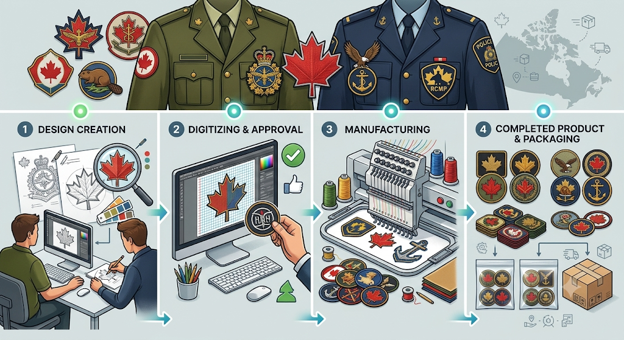
Bulk orders for a unit or department generally follow the same three-stage process as any custom patch order, with an added layer of internal approval before artwork is finalised:
- Submit the crest, insignia, or design brief along with any approved colour references and required backing type
- Review a free digital mockup showing size, colours, thread coverage, and backing before production starts
- Approve the proof and receive the finished patches, produced and shipped from a Canadian facility
Departments ordering across multiple patch types at once, such as shoulder flashes, name patches, and ID panels together, often start from the custom uniform patches, while units and agencies with a single insignia to produce typically go directly to the custom military patches or custom police patches to specify material, backing, and quantity.
Frequently Asked Questions
What patches are used on Canadian military uniforms?
Canadian military uniforms typically use formation patches, rank patches, name tapes, a Canadian flag patch, and unit or branch insignia, with colour and material chosen to match the specific uniform pattern, such as CADPAT for field dress or a subdued tone for tactical gear.
How are military patches made in Canada?
Canadian-made military patches are produced through embroidery, PVC moulding, or woven construction depending on the design, then finished with the specified backing, whether sew-on, Velcro, or iron-on, and quality-checked against the approved digital mockup before shipping.
How do I choose patches for military uniforms?
Start with the uniform’s fabric and pattern, confirm whether the patch needs to be permanent or swappable, match colours to an approved reference, and choose a construction, embroidered, PVC, or woven, that suits how visible or low-profile the insignia needs to be.
What makes a military patch durable?
Durability comes from a combination of factors: a merrowed or heat-cut border suited to the design, weather-resistant materials, colourfast thread, and a backing that is reinforced to withstand repeated handling, washing, or attachment and removal on tactical gear.
What is the difference between police and military patches?
Police patches generally follow a single department’s branding and colour palette in full colour, while military patches often use subdued or pattern-matched tones for field uniforms and follow unit or branch-level approval rather than municipal sign-off.
Embroidered vs PVC military patches, which is better?
Embroidery patches are great for dress uniforms and formation insignia with fine thread detail. PVC patches are ideal for tactical and low-visibility gear because they are weather-resistant and low-profile. Neither is better . It is contingent upon the uniform and the environment .
Sew-on vs Velcro military patches, which should I choose?
Sew-on patches suit permanent insignia on dress uniforms, while Velcro patches suit tactical gear and any application where patches need to be swapped between assignments without re-stitching.
How do I order patches for a police department?
Provide approved patch artwork, including colour references and any required backing in the correct format. Review a free digital mockup and confirm quantities prior to production commencing. For bulk departmental orders, internal design should also be pre-approved.
What information goes on a police uniform patch?
Standard elements include the department name or crest, jurisdiction, and in some cases a badge number, rank designation, or unit identifier, arranged according to that department’s existing design standards.
How do I order bulk uniform patches in Canada?
Bulk orders are quoted by patch style, size, and quantity, with pricing typically dropping per unit above 100 pieces. Most Canadian suppliers require a single approved mockup before producing the full run, which keeps every patch in the order consistent.
Getting Every Patch Right, From First Mockup to Full Deployment
There is little leeway for error in military and law enforcement uniforms, and a patch program that starts with the right material, backing, and colour reference tends to remain accurate through years of reorders.
Whether the current need is for a single formation patch, or a full departmental roll-out of shoulder flashes, name patches, and ID panels, beginning with a clear specification and an approved digital mockup is what keeps every subsequent order matching the first one.