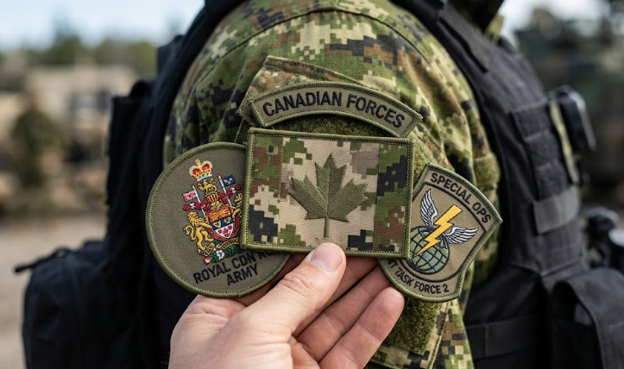
CADPAT Multi-Terrain (MT) Modernized Combat Uniform patches are becoming the new standard for identification on the Canadian Armed Forces Modernized Combat Uniform (MCU).
The landscape of Canadian military operational dress is undergoing its most significant evolution in decades. With the roll-out of the Modernized Combat Uniform (MCU), personnel across all environments are transitioning to an advanced, data-driven camouflage system.
This structural shift highlights the critical importance of high-quality CADPAT Multi-Terrain (MT) modernized combat uniform patches that preserve tactical integrity while ensuring clear identification.
For serving members, collectors, and kit shops alike, understanding the design features, operational applications, and logistical benefits of these updated insignia is essential for maintaining complete dress instruction compliance.
What Are CADPAT Multi-Terrain (MT) Modernized Combat Uniform Patches?
In the simplest terms, the Canadian Armed Forces patches are the authorized tactical insignia engineered explicitly to accompany the Canadian Armed Forces’ latest operational dress rollout. As the military transitions away from theatre-specific uniforms to a unified, multi-environment camouflage system, the traditional patches worn on operational gear required a comprehensive redesign.
The patches, which are specific in nature, are used to show the name, national flag, environmental branch, rank, and credentials of qualifications. As opposed to the traditional embroidery designs, they are not merely used for decoration but form part of the uniform system that is carefully designed in accordance with the technical and aesthetic standards of modern global operations.
Why Did the Canadian Armed Forces Adopt CADPAT MT?
This choice for the implementation of a singular camouflage design in the Canadian Armed Forces (CAF), made by the Department of National Defence, is an important step towards innovation in terms of defensive engineering, rather than simply aesthetics.
In the case of developing the world’s first operational digital pixel pattern during the late 1990s, the green-based Temperate Woodland (TW) and sandy-colored Arid Region (AR) configurations served as benchmark examples.
The current battlefield, however, is greatly transformed due to the rapid increase in surveillance technologies, such as high-resolution digitized photography, near-infrared optoelectronics, and infrared night-vision goggles. Modern CAF patches combine identification, durability, and camouflage performance in a single solution.
As a response to these threats, Defence Research and Development Canada (DRDC) employed software to analyze hundreds of photos from various combat zones and to calculate pixel color ratios in order to develop this five-color pixel pattern.
This mid-spectrum five-color design employs brown color dominance, making it possible to maintain maximum concealment effectiveness in varying environments, from grassy plains to lush forests, through desert areas and ruined urban zones. The development of the above-mentioned state-of-the-art camouflage fabric involved field validation through rigorous trials in real-world conditions.
Commencing in September 2019, under the framework of the SOCEM program, extensive field tests were performed at CFB Petawawa, with more than 600 participating soldiers from the ranks of 3rd Battalion, Royal Canadian Regiment, evaluating the performance of the initial four-colored camouflage pattern nicknamed “Prototype J” during rigorous combat exercises.
Based on successful tests and changes in color profiles, the optimal five-colored camouflage pattern for the new multi-terrain suit became the official choice in 2021. The rollout schedule, therefore, began with the official rollout of the multi-terrain suit in February 2024, starting with high-ready operational units.
With regard to logistics and supply management, this two-year transition process dramatically simplifies the military logistics chain by consolidating two different environmental uniforms into one versatile combat dress platform.
What Makes CADPAT MT Effective in Modern Combat Environments?
The transition away from legacy camouflage represents a pivot toward multi-environment versatility. Developed by Defence Research and Development Canada (DRDC), the multi-terrain configuration utilizes specialized pixelation software to calculate precise colour percentages from varied operational environments.
The resulting five-colour palette is medium-brown dominant, accented by khaki, sand, dark olive green, and trace elements of black. This specific blend significantly reduces detection ranges against modern optoelectronic sensors and optical sights, outperforming commercial alternatives in global conditions where Canadian troops are deployed.
Just like OCP patch placement requirements have to be fulfilled, military patches produced for the Canadian system must mirror exact spectral properties too. Authorized CADPAT patches utilize precise thread matching to ensure that unit identifiers, specialist badges, and national flags do not compromise the camouflage signature.
Unlike older legacy variants, modern Canadian disruptive pattern patches are built to control near-infrared reflectance, preventing the wearer from inadvertently standing out under night-vision surveillance.
This careful attention to detail preserves the signature-reduction benefits inherent to the modern combat textile. It is now time to look at the diverse types and who uses them:
CADPAT MT Command and Branch Patches
Maintaining institutional structure within a unified camouflage framework requires using specialized Canadian Commands & Branches patches designed specifically for the updated uniform patch hook-and-loop panels.
At the highest level of leadership, the Canadian Forces Badge and the VCDS Badge anchor institutional identity, alongside the comprehensive Canadian Forces Patch (Triservice), which represents joint operational environments.
Senior leadership and administrative components are clearly distinguished using the Canadian Command Badge, the Assistant Deputy Minister (Information Management) Badge, the ADM (Finance & Corporate Services) badge, the CMP Badge, and the rugged ADM Badge (Materiel Group).
Institutional oversight, corporate safety, and professional development are visually preserved via the Canadian Defence Academy badge, the public affairs shoulder patch, and the universally recognized general safety badge.
For administrative representation across diverse domestic sectors, personnel utilize the CFLC Badge or the unique First Nation Spiritual Advisor (FNSA) Patch to ensure inclusive institutional representation within operational spaces.
Joint Operations and Environmental Command Patches
The modernized uniform acts as a shared platform across all environments, streamlining structural design while honouring distinct operational traditions. Elements representing the senior branches rely on dedicated identifiers like tactical patches Canada, including specialized Canadian Army patches and Canadian Navy patches that maintain sub-surface and littoral unit traditions.
Air elements are seamlessly integrated using the Royal CDN Air Force Patch, while land and maritime operational elements are distinctly outfitted with the Royal CDN Army Patch and the Royal CDN Navy Patch, respectively.
Strategic command coordination and regional tracking are maintained through the deployment of the Air Command Badge, the historic Mobile Command Patch, the legacy CEFCOM Badge, and the modern CJOC Badge.
Strategic logistical deployment across the global theatre is represented by the Canadian Operational Support Command Badge, the Canadian Forces Europe Badge, the CF Northern Region Headquarters Badge, and the Canadian Forces Support Unit Badge (Europe).
At the tactical execution level, joint assets display their institutional alignment through the CF Joint Operations Group (CFJOG) Badge, the CFJOSG Crest, and the supportive CAF Transition Group badge.
Formation, Brigade, and Base Patches in the CAF
A primary requirement of the modern tactical uniform policy is the seamless integration of organizational heraldry into the low-visibility multi-terrain template. Large-scale deployments are organized using standardized Canadian formations and units patches that designate specific regional commands.
This includes the application of Military Crests: Brigade & ASG Group Badges, CDSG Badges, and the technologically critical 3 Canadian Division Support Group Signal Squadron (CDSG) identifier.
Regional combat teams display localized authority via the Tactical 34 Brigade Group Badge, the legacy Special Service (SSF) Patch, and the historic 1st Special Service Badge.
Base administrative entities and local command elements utilize authorized CFB & CFS badges alongside the CFB Kingston Formation Badge and the historic Camp Aldershot Badge to define domestic post alignment.
Civic pride and national heritage are preserved on the operational uniform through the New Brunswick Coat of Arms badge and the stately Royal Coat of Arms of Canada patch. Historical campaign connections are visually maintained through the Maple Leaf Up Patch, the UOI Patch, and the AOA Patch, which link current units to their decorated lineage.
Military Corps and Regiment Patches
Combat arms and combat support elements rely on heavy-duty, low-visibility embroidery to distinguish corps identities in field environments. Heavy mechanized elements leverage military crests: armoured corps badges alongside the historic 8th Canadian Hussars badge to mark their units.
Dismounted combat teeth elements are identified by military crests: Infantry Corps badges, which include the Le Régiment De Hull Cap Badge, the RCR Field Cap Badge, the Grey and Simcoe Foresters Regimental Moral Crest, and the elite Canadian Guards Badge. For field headgear configuration, standard field cap badges are optimized to prevent friction when worn beneath standard ballistic helmets.
Tactical communications, network security, and electronic warfare units display their technical specialities via military crests: communication branch badges, the CF Information Operations Group Badge, the CFIOG Badge, and the highly specialized CYBER Operational Badge. Fire support units utilize the 3rd Field Artillery Regiment Badge, the RCHA Badge, and the commemorative 150th Anniversary RCA Shoulder Badge to ensure flawless tracking during combined arms maneuvers.
Logistical networks keep frontline operations moving, and their personnel are identified via military crests: service battalion badges, the historical Royal Canadian Ordnance Corps badge, and localized distribution markers like the 1 Canadian Forces Supply Depot Badge, the 5 Supply Depot Badge, the CFAD Dundurn Badge, and the high-security Ammunition Depot Bedford Badge.
Furthermore, clerical, administrative, and transport tracking are designated by military crests: personnel branch badges, the combat clerk badge, the traffic technician (Wheel) badge, the heavy-duty HLVW wrecker badge, the advanced AHSVS wrecker badge, and the emergency CFARS badge.
Engineering, Intelligence, and CBRN Patches
Specialist capabilities demand distinct, high-contrast text or optimized low-visibility designs to ensure safe identification during hazardous tasks. Field engineering assets are distinguished by the Canadian Military Engineers Badge, the strategic 1 Engineer Support Unit Badge, the traditional Lazy E Sapper Badge, the operational Cartographie Militaire badge, and the precise Troupe Geomatique Badge (5 GBMC).
High-risk threat mitigation specialists are instantly recognizable by their EOD / IEDD patch, the heavy-clearing EROC badge, and the highly critical mission-specific CBRN patch.
Information warfare, human intelligence, and tactical counter-reconnaissance operate within the framework of the Canadian Forces Intelligence Command Badge. Personnel within this covert architecture are tracked via the Renseignement Badge, the highly secure Joint Task Force X Badge, the inter-agency Joint Ops Fusion Lab Patch, and the advanced tactical Canadian Joint Warfare Centre Patch.
Canadian Special Operations Patches
The sharpest edge of the nation’s defensive architecture demands custom military patches Canada built to withstand extreme environmental stress while offering immediate identification within closed teams. Elite configurations are organized under Canadian Special Ops patches, which match strict low-visibility field guidelines.
Overall command identification is displayed via the CANSOFCOM Badge and the corresponding Special Operations Force Branch Badge. Tier-one counter-terrorism operators are outfitted with Joint Task Force 2 patches for direct tactical assignments.
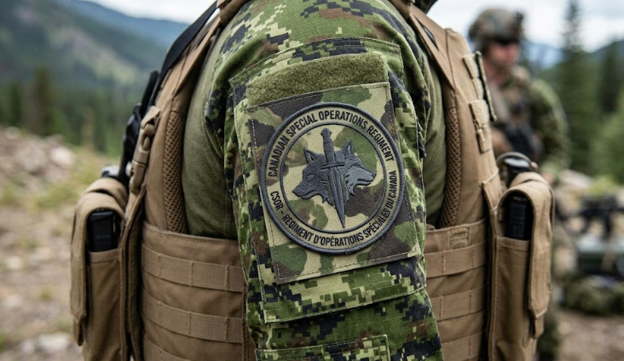
Kinetic strike and specialized air-assault support elements are designated using Canadian Special Operations Regiment patches, the classic Canadian Special Operations Regiment (CSOR) badge, and the elite 427 Special Operations Aviation Squadron patches. High-tier chemical, biological, and radiological response teams utilize Canadian Joint Incidence Response unit patches alongside the functional CJIRU badge to denote their emergency status.
Crucial institutional development and selection validation within this elite architecture are marked using Canadian Special Operations Training Centre patches, the grueling Canadian Special Forces Basic Qualification patch, and the specialized close protection patch. Historical and international deployment heritages are preserved through the collection of the Task Force Kandahar patch, the Task Force Tripoli badge, and the allied training OP UNIFIER badge.
Medical, Chaplaincy, and Aviation Patches
Field medical support and spiritual care require quick visual identification to facilitate rapid care during mass casualty or high-stress situations. Overall medical asset grouping is designated by the Health Services Group badge and the regionally coordinated 1 Health Services Group badge.
Field trauma teams utilize the 1st Field Ambulance badge and the historical 15 Field Ambulance Association badge for clear identification. Spiritual guidance and field morale support are designated on the uniform via the Royal Canadian Chaplain Service Badge, while logistical theater communication is supported by the CF Postal Unit European Postal Unit Badge.
Specialized search, rescue, and aviation crew positions are marked using the Search Master Badge, the Army Marksmanship Badge, and the standard Air Flight Crew (2×4) badge. Airframe-specific tracking is maintained through the use of the E-3A IMP Badge and the specialized rotary-wing Canada Cormorant Badge.
Internal base safety, peer monitoring, and mental health crisis support teams are designated via the Sentinel-Sentinelle Operational Badge, the Sentinel-Sentinelle Badge, and the easily scannable Sentinel-Sentinelle (circle badge).
Ranger, Cadet, and Heritage Patches
Domestic sovereignty protection across remote coastlines relies on the rugged Canadian Ranger Patrol Group Patch to maintain authority. Youth training programs and heritage foundations utilize dedicated patterns, featuring Canadian Cadet patches and the multi-organizational CJCR–CRJC shoulder patch, to build institutional pride. Localized training groups use the CFB Borden Army Cadet Badge to align with current base protocols.
Veteran service, transition tracking, and community support are displayed via the veteran’s NATO-OTAN patch and the civilian-supported Royal Canadian Legion patch. Localized militia and reserve regiment components retain their heritage markings through specialized uniform accessories like the QYRang Cap and the comfortable QYRang Polo.
Training School and Military Academy Patches
Validation of combat readiness and leadership excellence requires institutional insignia that command respect across all branches. Overall doctrine development is represented by the military crests: CF schools, college & training center badges, the Combat Training Centre Badge, and the high-visibility Combat Training Centre with scroll badge.
Major field validation environments are designated by the Canadian Manoeuvre Training Centre (CMTC) badge and the comprehensive CADTC badge. Officer professional development and tactical research foundations are visually anchored by the prestigious RMC Crest Badge, the historic CMRSJ Badge, the specialized CALWC Unit Army Badge, and the technical Proof and Experimental Test Establishment Badge.
CADPAT MT Patch Placement Guidelines
Proper placement of insignia on the Modernized Combat Uniform (MCU) is essential for maintaining a sharp appearance and adhering to the Canadian Armed Forces (CAF) dress instructions.
The MCU utilizes built-in hook-and-loop panels designed to hold multi-terrain patches perfectly flush, which eliminates exposed fastener space and significantly reduces the near-infrared (NIR) signature of the uniform. To pass inspection and maintain tactical integrity in the field, members must adhere to specific placement zones:
Name Tapes
A standardized name tape matching the multi-terrain base cloth will be worn horizontally above the chest. The member’s last name should appear at the centre front portion of the chest panel, precisely aligned with the seams of the garment to ensure that it lies completely flat.
Flag Patches
The national identifier will be placed on the upper left sleeve panel. In garrison settings and for office-related activities, a full-colour miniature Canadian flag in red and white colours is used. However, when undertaking operations or training, the full-colour flag is replaced by a camouflage one in green or brown colours.
Unit Insignia
The authorized formation patch, environmental command, and unit identifier will be placed on the upper sleeve hook-and-loop panel. While the senior formation badge will be placed on the left sleeve beneath the national identifier, special domestic unit numbers or specific task force identifiers will be placed on the right sleeve beneath the national identifier.
Qualification Badges
Special identifiers like professions and advanced tactical qualifications can only be worn in specific places on the uniform. With respect to the new set of uniforms, the total number of badges to be worn and their size are greatly limited to ensure maximum efficiency when camouflaging. The approved qualification marks are strictly limited to 2×2 inches to fit properly in the designated area.
Benefits of CADPAT MT Uniform Patches
Integrating purpose-built tactical insignia into the modernized clothing system offers distinct practical and tactical advantages for personnel operating in complex environments. Investing in high-specification multi-terrain insignia delivers several measurable benefits:
Better Camouflage Integration
Custom CADPAT MT patches use precisely the same multi-environment five-colour matrix, thus blending smoothly within the general outline of the item. This eliminates the sharp high-contrast borders typical of old-school insignia design and minimizes any possibility of exposing one’s location under field conditions.
Reduced Visibility Under NIR
All high-quality military patches Canada come with special coatings to mitigate the reflectance of near-infrared light. Such coating technologies make the embroidery threads and substrates non-fluorescent under modern surveillance systems based on night vision technology.
Easy Identification
Despite having optimal camouflage qualities, insignia retain their excellent legibility, ensuring fast and reliable identification by team members both in office and combat environments. Precision digitized layouts allow for clear recognition of text, division boundaries, and trades.
Durability
Being designed for extreme environmental conditions, such items are manufactured from high-density polyester or nylon stitching material. This makes them resistant to abrasion caused by contact with heavy loads and reduces fading from ultraviolet light exposure. In addition, these products resist shrinking during high-temperature washing cycles.
Quick Replacement via Hook-and-Loop Backing
Thanks to the built-in Velcro fastener backing, one can easily reconfigure the appearance of the clothes and gear. Personnel can quickly replace full-colour flag insignia with subdued alternatives, change unit identifiers upon institution rotation, and remove special badges when washing gear in seconds.
Materials and Construction of CADPAT MT Patches
At the heart of Tactical Patches Canada lies the commitment to durability and quality standards aimed at coping with the tough realities of service. They are manufactured from high-tensile and colour-fast polyester or nylon stitching placed on the top of strong twill or special camouflage fabric material resistant to wear, washing, and adverse climatic conditions without wearing out or losing their colors.
In order to provide a range of different combinations with uniforms, they can be provided with several types of backings, including Velcro hook and loop military patches for quick swapping on combat clothing and sewing or iron-on techniques for more durable use.
The edges are finished with clean, laser-cut borders to prevent loose threads or traditional merrowed borders for a classic, reinforced look that holds its shape over years of deployment.
Tiered wholesale pricing structures ensure that large organizational orders, unit kit shop restocks, and custom production runs remain highly cost-effective, providing exceptional value without compromising on rigorous spectral specifications or structural integrity.
Customization and Prototyping Services of CADPAT MT Patches
Digitizing and verifying an elaborate crest or squadron logo within a camouflage pattern requires precision and careful consideration of all elements. High-quality digitizing processes are utilized by specialized manufacturers, using the most sophisticated computer-aided design systems to ensure that even the finest text, unique insignia, and intricate border elements will remain clear in scale when reproduced at precise, uniform sizes.
Prior to launching into full production batches for a particular brigade or unit, prototypes are produced in either hard copy or high-quality electronic format for approval by command authorities. Such a joint effort ensures compliance with all camouflage specifications regarding thread colors and structural design symmetry of the finished insignia in honor of their proud legacy and professionalism.
Frequently Asked Questions
What is the main difference between CADPAT MT and older versions like TW or AR?
The newer multi-terrain pattern features a medium-brown dominant palette developed through data-driven digital analysis to reduce detection across a wider variety of global environments. Legacy Temperate Woodland is green-dominant for dense forests, while Arid Region is tan-dominant for desert settings, making the modernized multi-terrain configuration a far more versatile single-issue solution.
Are these modernized uniform patches authorized for official operational wear?
Authorized insignia produced using exact multi-terrain colour specifications and near-infrared reflectance controls are fully compliant with current Canadian Armed Forces dress instructions. Serving members should always verify with their specific chain of command regarding localized unit policies or specialty qualification configurations.
How do the hook-and-loop backings perform in extreme winter or muddy environments?
Premium-grade hook-and-loop fastener systems are specifically engineered to maintain structural grip across extreme temperature shifts ranging from deep sub-zero Arctic conditions to intense moisture and mud exposure. Regular clearing of debris from the fastening panels ensures long-lasting adhesion throughout rugged field training cycles.
Unit kit shops and authorized suppliers can customize design elements, tactical text, and borders provided they adhere strictly to official colour palettes and dimensional specifications. This ensures that unique unit identities are fully preserved without degrading the camouflage performance of the uniform system.
Order Custom CADPAT MT Patches Built for Operational Performance
The transition to the CADPAT Multi-Terrain (MT) modernized combat uniform patches demands tactical patches that match its advanced engineering. Eagle Patches Canada delivers professional-grade, compliant options built to withstand the rigours of deployment while maintaining perfect visual harmony with your operational apparel.
Whether you are outfitting an entire brigade, upgrading a specialized unit kit shop, or honoring a proud military legacy, our durable production standards guarantee flawless clarity and performance in the field. Contact us today to request a quote or submit your custom design specifications for precise multi-terrain replication.