
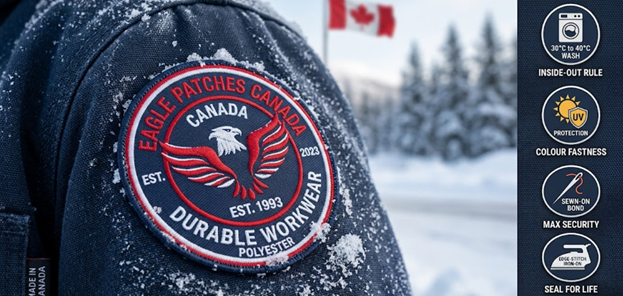
A patch that frays after two washes is a waste of your branding budget. Whether it is on a hockey jersey or a corporate parka, your embroidery needs to survive the Canadian elements. Embroidery density, the number of stitches packed per square centimetre of patch surface, determines structural integrity, colour vibrancy, and resistance to fraying under repeated washing and outdoor exposure.
Low-density embroidery looks thin, gaps between thread rows show the base fabric underneath, and the edges fray within a season. High-density custom embroidery patches use tight stitch counts that lock thread rows together, seal the design surface, and hold the merrowed border firm through years of Canadian weather.
This guide covers every maintenance, washing, repair, and storage technique that extends the life of custom embroidered patches Canada orders from months to decades.
The Cold Reality: Why Canadian Winters Are Hard on Thread
Road salt and freezing moisture are the enemies of rayon threads. Eagle Patches Canada uses high-tensile polyester threads because they resist the chemical breakdown caused by winter road treatments.
This distinction matters more in Canada than in almost any other market. Canadian road salt applications run from October through April across most provinces. Salt spray from highway traffic coats outdoor gear, workwear jackets, and team bags with a chemical residue that attacks natural and semi-synthetic fibres at the molecular level.
Rayon thread is the standard embroidery thread in budget patch production. It absorbs moisture, swells, and weakens under repeated salt exposure. The thread fibres break down chemically and the stitch tension loosens, which causes top-stitch gaps and accelerates edge fraying.
Polyester thread resists this breakdown completely. The synthetic polymer structure does not absorb moisture, does not react to road salt chemistry, and maintains tensile strength through the full freeze-thaw cycling that Canadian winters deliver from November to March.
The thread type comparison for Canadian conditions:
| Thread Type | Moisture Absorption | Salt Resistance | UV Resistance | Tensile Strength | Best Canadian Use |
| Polyester | Very Low | Excellent | High | High | Outdoor workwear, tactical gear, sports jerseys |
| Rayon | High | Poor | Medium | Medium | Indoor uniforms, decorative patches, light-duty use |
| Cotton | Very High | Poor | Low | Low | Heritage patches, display items, low-wash applications |
| Metallic | Low | Medium | High | Medium | Ceremonial, corporate awards, limited outdoor use |
The “Inside-Out” Laundry Rule for Maximum Longevity
Always turn your garment inside out before tossing it in the machine. This simple move prevents the embroidery from rubbing against zippers or buttons that shred the top-stitch.
The washing machine drum is a high-abrasion environment. Garments tumble against each other, against the drum wall, and against their own hardware, zippers, buttons, eyelets, and buckles throughout the wash cycle.
Inside-out washing eliminates direct abrasion contact on the embroidery surface completely. The patch face presses against the interior of the garment, while the exterior of the garment takes the drum contact.
Temperature threshold: 30°C to 40°C maximum for machine washing embroidered patches.
At 30°C on a gentle cycle, dye release is minimal, adhesive remains stable, and thread fibre structure stays intact. The garment cleans effectively at this temperature, the lower heat is a patch protection measure, not a cleaning compromise.
The complete washing protocol for custom embroidery patches:
- Turn the garment inside out
- Close all zippers, buttons, and Velcro fasteners
- Use a mesh laundry bag for patch-heavy garments
- Select gentle cycle at 30°C to 40°C
- Use a mild liquid detergent, powder detergents contain abrasive particles that scratch thread surfaces
- Skip the spin cycle on delicate embroidered garments, high-speed spinning stresses thread anchors
One additional rule for custom patches on workwear that goes through commercial laundry services: specify cold wash and gentle cycle in the garment care instructions provided to the laundry operator. Commercial washers run at 60°C to 80°C as standard.
To Iron or to Sew? Choose the Strongest Bond
The bond between a patch and a garment determines how long the patch survives the Canadian elements, independent of how well the embroidery itself is made. A perfect patch on a failing bond falls off. The right bond choice starts with understanding what the garment does every day.
| Bond Type | Best For | Wash Safety | Repositionable | Durability | Notes |
| Iron-On | Casual wear, jackets, caps | Moderate (up to 40°C) | No | Medium | Quick to apply, not ideal for stretchy or outdoor workwear; bond weakens with repeated washing or heat |
| Sew-On | Workwear, uniforms, outdoor gear | High (up to 60°C) | No | Very High | Most secure method, handles stress and repeated wash cycles; requires sewing skill or machine |
| Velcro Loop | Tactical vests, modular gear, team rotation | Moderate (up to 40°C) | Yes | High | Ideal for removable patches; keeps garment clean and patch reusable |
| Adhesive Backing | Helmets, hard surfaces, temporary use | Low | Yes | Medium | Only for rigid, smooth surfaces; not for fabric; limited outdoor longevity |
Sun Fade and UV Protection: Keeping Colours Sharp
Canada delivers strong UV exposure across summer months. Particularly in the Prairie provinces and British Columbia interior where UV index regularly reaches 8 to 10 from June through August. Thread colour on embroidered patches fades through photochemical degradation: UV radiation breaks the molecular bonds in dye compounds, and the colour shifts toward grey or yellow over accumulated exposure hours.
Practical UV protection measures for embroidered patches on outdoor gear:
- Store garments away from direct sunlight between uses. A work jacket hung near a south-facing window accumulates UV exposure hours every day it sits there unused. A locker or a dark storage bag eliminates this passive fading completely.
- Apply UV-protective fabric spray to the garment surface. Products designed for outdoor fabrics, marketed for tent and awning protection, apply a UV-filtering coating to the fabric surface that extends thread colour life on patches. Reapply after every five to ten washes as the coating gradually washes out.
- Specify high colour fastness thread in the patch order brief. Eagle Patches Canada uses ISO 105-rated polyester threads as standard on all outdoor and workwear orders. Request the colour fastness specification at order stage, budget suppliers rarely use rated thread stock.
- Dark and saturated thread colours fade faster than light colours under UV. Deep navy, bright red, and forest green thread colours carry higher dye concentrations that absorb more UV energy per unit area.
FAQ
Can you dry clean embroidered patches?
Yes. Professional dry cleaning is safe for embroidered patches and produces less mechanical stress on thread and backing than machine washing. Inform the dry cleaner that the garment carries iron-on backed patches.
How long do custom embroidered patches last?
A quality polyester-threaded patch with a sewn bond on a well-maintained garment lasts 10 to 15 years of regular use. Iron-on patches with edge-stitching reinforcement last 5 to 8 years under the same conditions.
Does the backing type affect lifespan?
Significantly. Sewn-on backing outlasts iron-on backing by a factor of three to five in wash-cycle durability. Iron-on backing with edge-stitching sits between the two closer to sewn performance than iron-on alone.
Can embroidered patches go in the dryer?
Air drying is strongly recommended. Tumble dryer heat above 40°C softens iron-on adhesive and causes progressive bond failure. The mechanical tumbling action also abrades the embroidery surface, less damaging than a washing machine on a full cycle, but cumulative across many dry cycles.
Get Quality That Survives the Great White North
Canadian gear takes punishment that most markets never see. Six months of salt, cold, and freeze-thaw cycling separate a quality custom patches order from a budget one faster than any other test environment on the planet.
Eagle Patches Canada produces custom embroidered patches Canada orders with ISO-rated polyester thread, high-density twill backing, and merrowed borders built to outlast the garments they go on. Every order gets the thread spec, the stitch density, and the backing recommendation that matches the actual conditions the patch will face