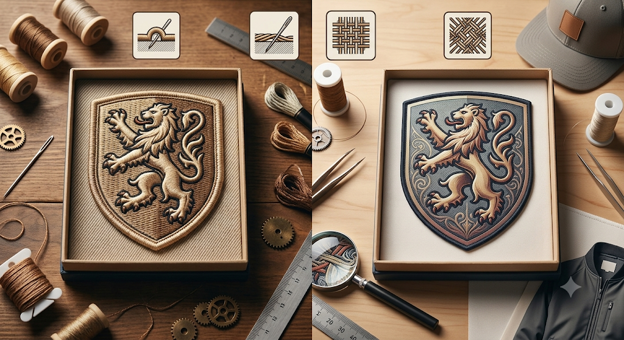
Embroidery vs woven is one of the first questions almost every Canadian buyer runs into when they start pricing out custom patches. Both styles use thread to build a design, both hold up to years of wear, and both look great on jackets, uniforms, and hats, but they are made differently, and that difference changes how your design looks, feels, and performs.
This guide breaks down exactly how embroidered patches and woven patches compare on detail, texture, durability, and cost, so you can choose the right style before you place an order.
Eagle Patches Canada produces both custom embroidered patches and custom woven patches for brands, sports teams, and military and public safety units across the country, so this comparison reflects what actually happens on the production floor, not just theory.
What Is an Embroidered Patch?
An embroidered patch is made by stitching coloured thread onto a base fabric, usually twill, using an embroidery machine that follows a digitized design file. The stitches sit on top of the fabric, which gives embroidered patches a raised, textured surface. Thicker thread coverage means bold outlines, solid colour blocks, and classic logo shapes come through clearly. Many embroidered patches also use a percentage of visible background fabric, called twill show, to keep costs down while still looking sharp from a distance.
Because the design is built with individual stitches, embroidered patches work especially well for chunky lettering, mascots, crests, and traditional military or motorcycle club emblems. For an even bolder, raised look, some buyers upgrade to 3D puff embroidery, which adds foam backing under the stitching for a sculpted, dimensional effect.
What Is a Woven Patch?
A woven patch is made on a loom rather than an embroidery machine. Fine polyester threads are woven directly into the fabric itself, similar to how a shirt label or a jersey crest is produced.
Because woven patches use a much higher thread count and a flatter construction, they can reproduce small text, fine linework, and subtle colour gradients that would blur together in standard embroidery. The finished patch has a smoother, flatter surface with almost no visible fabric background.
Woven patches are the go-to choice when a design includes tiny fonts, thin outlines, or a photo-like level of detail, think small brand logos on the side of a cap, detailed university crests, or sports jerseys with layered graphics.
Embroidery vs Woven Patches: Key Differences at a Glance
| Feature | Embroidered Patches | Woven Patches |
|---|---|---|
| Construction | Thread stitched onto twill backing | Thread woven directly into the patch fabric |
| Texture | Raised, textured surface | Flat, smooth surface |
| Detail level | Best for bold shapes and thick lines | Best for fine detail, small text, gradients |
| Typical thread density | Lower stitch count | Much higher thread count |
| Small text legibility | Can blur below 6-7 point equivalent | Stays crisp even at small sizes |
| Best patch sizes | 1.5 inches and larger | Works well from under 1 inch upward |
| Cost for detailed designs | Rises with stitch count | Often more economical for intricate art |
| Common backings | Iron-on, sew-on, velcro | Iron-on, sew-on, velcro |
| Classic use case | Military, uniform, motorcycle patches | Corporate logos, sports crests, small caps |
Which Offers More Detail: Woven or Embroidered?
Woven patches win on fine detail. Because the threads are woven at a much tighter density than embroidery stitches, a woven patch can hold thin lines, small serif fonts, and multi-colour gradients without the design looking muddy.
Embroidered patches can absolutely handle detailed artwork too, but very fine elements usually need to be simplified or thickened slightly during digitizing so the stitches do not collapse into each other. If your design leans heavily on small text or a busy illustration, woven construction will usually reproduce it more accurately.
Durability: Do Woven Patches Last as Long as Embroidered Patches?
Both patch types are built for years of regular wear, washing, and outdoor exposure, but they age slightly differently. Embroidered patches have a thicker, denser stitch structure, which gives them strong resistance to fraying and makes them a favourite for rugged, high-contact applications like tactical gear, motorcycle jackets, and outdoor workwear.
Woven patches are thinner and flatter, so they are less likely to snag on zippers or straps, but the finer threads can show wear slightly sooner on patches that get heavy daily friction. For most everyday applications, both hold up well for the life of the garment.
Cost Comparison: Woven Patches vs Embroidered Patches
Pricing for both styles depends on size, quantity, colour count, and backing option rather than the construction method alone. As a general starting point. Where the two styles diverge is on detailed artwork: a highly intricate design often costs more in embroidery because of the added stitch count needed to approximate fine detail, while the same design in woven form can be produced at a similar or lower price since the loom naturally handles fine lines without extra stitching. You can see current ranges and get an exact quote for your artwork on the pricing page.
Texture and Feel: Choosing Based on Look
If you want a traditional, slightly raised patch that you can feel with your fingertips, embroidery delivers that classic look, especially on jackets, hats, and varsity-style apparel. If you prefer a sleek, low-profile finish that sits almost flush with the fabric, similar to a woven clothing label, a woven patch will give you that smoother feel while still standing out visually through colour and contrast.
Best Use Cases for Embroidered Patches
- Military, police, and public safety insignia that need a rugged, official look
- Motorcycle club patches and biker vests where texture and tradition matter
- Uniform patches for trades, hospitality, and corporate workwear
- Bold team crests, mascots, and merit or achievement badges
Ordering custom uniform patches in Canada is the best option if your project falls into uniform branding specifically.
Best Use Cases for Woven Patches
- Small logo patches on caps, beanies, and polo shirts
- Corporate branding with gradients, thin typography, or layered icons
- Sports jerseys and crests packed with fine detail
- Event or club patches where the design includes small print, dates, or coordinates
Custom patch trends in Canada for 2026 have been showing up more often in newer branding work too.
Can You Combine Embroidery and Woven Elements on One Patch?
Yes. Some designs benefit from a hybrid approach, using embroidery for the bold outer border or lettering and a woven or printed centre panel for fine detail, small text, or a photo-style graphic.
This is common on patches that need both visual impact from a distance and readable fine print up close, such as a badge with a large emblem and a small motto underneath.
If you are unsure which construction fits your artwork, our team reviews the file through our embroidery digitizing process and recommends the best build before production starts, at no charge.
How to Choose Between Woven and Embroidered Patches
- Does your design include small text or fine linework? Choose woven.
- Do you want a raised, traditional textured patch? Choose embroidery.
- Is the patch going on rugged outdoor or tactical gear? Embroidery typically holds up better.
- Is the patch smaller than 1.5 inches? Woven usually keeps detail cleaner at small sizes.
- Is budget the deciding factor for a highly detailed design? Woven is often more economical.
- Still not sure? Send your artwork in and our design team will recommend a style with your free mockup.
Ordering Custom Embroidered or Woven Patches in Canada
Eagle Patches produces custom patches for teams, clubs, and businesses from our Cornwall, Ontario facility, with a minimum order of just 10 patches, free design mockups, and free shipping across every Canadian province. Every order, regardless of construction style, goes through the same process: you send your logo or idea, our team builds a free digital proof, and production starts only once you approve it.
Frequently Asked Questions
What is the difference between a woven patch and an embroidered patch?
An embroidered patch is stitched with thread onto a twill backing, creating a raised, textured surface best suited to bold designs. A woven patch is made on a loom with fine, tightly packed threads woven into the fabric itself, giving it a flatter finish and much better fine-detail reproduction.
Are woven patches cheaper than embroidered patches?
Not always. Basic designs cost about the same in either style. For highly detailed artwork with small text or fine lines, woven patches are often more affordable because the loom process does not require the extra stitching that detailed embroidery needs.
Which is better for small text, woven or embroidered?
Woven patches handle small text more clearly because their thread density is much higher than standard embroidery. Embroidered patches can still include small text, but very fine lettering may need to be enlarged slightly during digitizing to stay legible.
Do woven patches feel different from embroidered patches?
Yes. Embroidered patches have a raised, textured surface you can feel with your fingertips, while woven patches sit flatter against the fabric with a smoother finish similar to a clothing label.
Can I get a 3D puff effect with woven construction?
No, the 3D puff or sculpted look is exclusive to embroidery, since it relies on foam backing under the stitching. If you want dimensional texture, embroidery, including 3D embroidery, is the right choice rather than woven.
Which patch type lasts longer, woven or embroidered?
Both are built for years of use. Embroidered patches tend to resist fraying slightly better on high-friction, rugged gear because of their denser stitch structure, while woven patches resist snagging better thanks to their flatter profile. Either option holds up well under normal wear and regular washing.
What is the minimum order for custom woven or embroidered patches in Canada?
Eagle Patches Canada has a minimum order of 10 custom patches for both embroidered and woven styles, along with every backing option, including iron-on, sew-on, and Velcro.
Which patch type is better for uniforms?
Embroidered patches are the traditional choice for uniforms because of their durable, textured finish and classic appearance. Woven patches are a strong alternative when a uniform patch includes smaller lettering, such as a name, rank, or department detail, that needs to stay sharp at a smaller size.
Choosing Between Embroidered or Woven?
There is no universally better option between embroidered and woven patches, only a better fit for your specific design. Choose embroidery for a bold, traditional, raised patch that can take a beating on rugged gear, and choose woven when your artwork depends on fine detail, small text, or a flatter, more polished finish.
Whichever style fits your project, sending your artwork in for a free mockup at Eagle Patches CA is the fastest way to see exactly how it will translate onto fabric before you commit to an order.