
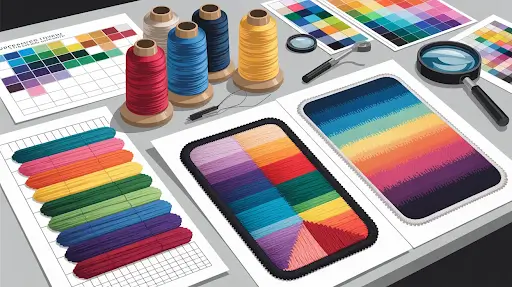
You can have the cleanest logo on earth, but if the patch colours come out “almost right,” it still feels wrong. Brands notice. Teams notice. That one person in marketing who lives in the brand guidelines definitely notices.
When you’re ordering Custom Patches, colour matching is where great patches become “yup, that’s us.” And it’s also where people get surprised, usually because thread and printing behave very differently.
This guide explains the real-world limits of thread colour, what happens to gradients, and when printed styles like sublimated patches are the smarter choice.
Colour Matching for Patches
Thread-based patches like embroidered patches match colours using available thread shades, so exact brand colours and gradients may be approximated. Printed patch styles like sublimated patches reproduce gradients and complex colours more accurately. Choose embroidery for texture and durability, and choose printing when colour accuracy and gradients matter most.
Why Colour Matching Works Differently on Patches
On screens, colours are light. On patches, colours are physical material.
- Thread reflects light differently than ink
- Stitch direction can change how a colour looks
- Dark fabrics can make colours appear muted
- Small details force simplification
That’s not a problem. It’s just the reality of turning digital design into a stitched product.
If you want creative ways to use patch colour intentionally for branding and merch, this post fits nicely with colour planning: Creative and Unexpected Ways to Use Custom Patches in Canada.
Thread Limitations in Embroidered Patches
Embroidered patches are popular because they look premium and feel textured. But thread has limits.
1) Thread colours are a set palette, not infinite
Threads come in a large range, but not every exact brand colour exists. That means some colours are matched to the closest available shade.
Practical tip: if your brand uses a very specific neon, pastel, or metallic tone, expect a close match, not a perfect clone.
2) Small details can shift colour perception
Tiny areas of colour can look darker or lighter depending on stitch density. A thin outline in bright thread might appear less bright once stitched tightly.
3) Gradients do not translate cleanly to thread
True gradients are smooth transitions. Thread is not smooth colour blending. Embroidery can simulate gradients with shading techniques, but it is still an approximation.
If your logo depends on a smooth gradient or a photo-style effect, you are usually better off with a printed approach.
When Printing Wins for Custom Patches
Printing does what thread cannot.
Sublimated patches for gradients and full colour
Custom sublimated patches are the go-to for:
- gradients
- complex colour palettes
- photo-style graphics
- detailed artwork with shading
Printing keeps colour transitions clean and makes the patch look closer to your digital design.
Woven patches for crisp detail with clean colour blocks
If your main issue is tiny text and fine lines, Custom woven patches are often the answer. They do not solve gradients like sublimation, but they keep detail sharper than embroidery.
PVC patches for solid, bold colours
Custom PVC patches are not about perfect brand colour matching, but they do great with bold, solid colours and high contrast designs. They are also rugged, which matters for outdoor gear and workwear.
Choosing the Right Patch Style Based on Colour Needs
Choose embroidered patches when
- you want premium texture
- your design uses solid colour blocks
- your logo is simple and bold
- durability and classic look matter most
Choose sublimated patches when
- you need gradients
- you need exact colour transitions
- your design has many colours
- you want a “close to the screen” look
Choose woven patches when
- the logo has small text
- detail and readability matter more than texture
- you want a clean, modern finish
Choose leather patches when
- you want a subtle, premium look
- your brand works better in minimal form
- you prefer debossed or simple designs over colour complexity
If you are still deciding which option fits your design and use case, this guide makes choosing a Canadian supplier and style easier: Where Can I Get Custom Patches Made in Canada?
Proof Tips That Prevent Colour Surprises
Colour issues usually come from assumptions. Here’s how to lock things in.
Share brand colour references
If you have Pantone values or brand hex codes, share them. It helps the production team aim for the closest match.
Tell us what matters most
Do you care more about matching one key colour perfectly, or preserving overall look and contrast. This changes how we approach the thread choices.
Approve the proof carefully
A good proof will show colour direction and layout. It is your chance to adjust before production.
Plan for fabric influence
Custom Patches on dark jackets can look different than patches on white shirts. If the patch will live on a dark uniform, we may recommend brighter thread or higher contrast borders.
Quick Pick for Colour Decisions
| Design feature | Best patch type | Why |
| Smooth gradients | Sublimated patches | Printing handles colour transitions |
| Small text and detail | Woven patches | Cleaner lines and readability |
| Bold logo with solid colours | Embroidered patches | Classic texture and durability |
| Outdoor use and rugged gear | PVC patches | Tough and high contrast |
| Minimal premium branding | Leather patches | Clean, subtle finish |
FAQs
Can embroidered patches match my exact brand colours?
They can match closely, but thread colours are limited to available shades. Some colours will be approximated to the nearest match.
What if my logo has gradients?
Gradients are best handled with sublimated patches. Embroidery can simulate gradients, but it will not look as smooth as printing.
Do printed patches last as long as embroidered patches?
Printed patches can be durable, but embroidery is usually the toughest for heavy wear. The best choice depends on where the patch will be used.
How do I avoid colour surprises when ordering custom patches?
Share colour references, keep strong contrast, and review the proof carefully before production.
Which is better for a clean modern look, woven or embroidered?
Woven patches often look cleaner for detail and small text. Embroidered patches look more textured and classic.
Match the Method to the Design!
Colour matching is not about perfection on paper. It is about choosing the patch style that makes your design look right in the real world.
If your logo is bold and simple, embroidery can look premium and durable. If your design depends on gradients and exact colour transitions, printing like sublimation is the smarter play. Eagle Patches CA can help you pick the best patch type for your artwork, so your Custom Patches look like your brand, not a close cousin.